Ask a city manager whether they want AI helping residents. Almost all of them say yes.
Then ask when it's going live.
That's when you get the real answer. "We're scoping it." "It's in the FY27 budget." "We're waiting on IT." "There's a committee."
Somewhere between the yes and the launch is where government AI goes to die. Not because the technology doesn't work — the technology works fine. Because the project doesn't work.
The Eighteen-Month Death March
Here's the standard playbook for AI in local government, and you already know it by heart:
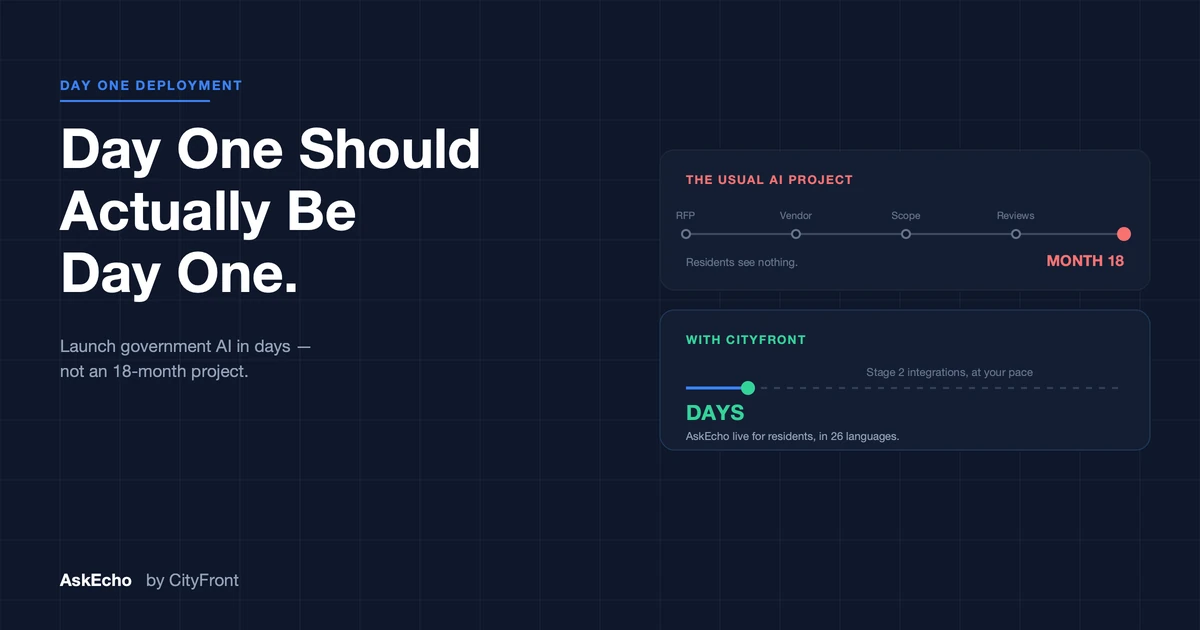
A committee forms. An RFP gets written. Six to nine months later a vendor is selected. Then the integration project gets scoped, which means IT gets handed a new thing to own on top of the eleven things they already own. Then there's a data governance review. Then a security review. Then a pilot — scheduled for month eighteen, assuming the sponsor who championed it is still in the job.
Meanwhile, residents are still calling. Still waiting on hold. Still getting told to call back during business hours.
The root problem isn't procurement discipline. Procurement discipline exists for good reasons. The problem is that cities are running AI through an enterprise-software process designed for replacing a financial system — an eighteen-month, seven-figure, rip-and-replace process — when the first useful version of this should take days.
What If Day One Was Actually Day One?
Here's the alternative, and it's how CityFront actually deploys.
Stage One is a JavaScript snippet on your website. That's the install. AskEcho goes live against the content you already publish — your service pages, your FAQs, your fee schedules, your meeting calendars, your buried PDFs.
No integration project. No new system of record. No procurement drama. Days, not quarters.
On Day One, AskEcho will:
- Answer resident questions conversationally, from your approved content only
- Do it in 26 languages, without you translating anything
- Do it at 11pm on a Tuesday, on a weekend, and during the holiday closure
- Never invent an answer — it retrieves from your approved sources, so it doesn't hallucinate a fee amount or make up a permit deadline
And here's the part most vendors won't say out loud: on Day One, it will not complete a permit application. It will not take a payment. It will not create a service request in Cityworks.
It can't do those things yet, because it isn't connected to the systems that do those things. That's Stage Two.
Anyone who tells you their AI does all of that on the first day is showing you a demo, not a deployment.
"Just Content" Is Not a Small Thing
It's tempting to dismiss Stage One as the easy part. It isn't the easy part — it's the part that finally makes the content you already own actually usable.
Think about the calls your 311 line, front desk, or general inbox handles this week. A large share of them are questions your website technically already answers. Trash pickup schedule. Permit requirements. Park reservation rules. Where to pay. When the office is open.
The answer exists. It's on page four of a PDF, linked from a subpage, behind a site search that returns nothing useful. So the resident does the rational thing and calls a human.
Stage One takes that same content and makes it conversational, multilingual, and available around the clock. Nothing about your systems changes. The resident experience changes completely.
The Part That Builds Your Business Case
There's a second thing Stage One does, and for a city manager it might be the more valuable one.
Every question a resident asks is a signal. After a few weeks of real traffic, you don't have to speculate about which services drive your call volume — you can see it. You know which departments residents are actually trying to reach, which tasks they're trying to complete, and which languages they're asking in.
That's your integration roadmap. Built from evidence instead of from whoever argued hardest in the budget meeting.
So when you go to fund Stage Two, you're not pitching a hypothesis. You're pointing at data from your own residents and saying: this is where the volume is, so this is what we connect first.
Stage Two: As You Grow
Once you know where the demand is, integrations get added one channel at a time — typically four to eight weeks per channel — into the systems your departments already run on. Cityworks. Dynamics. Tyler. Accela. CivicPlus. OpenGov.
This is where AskEcho stops answering and starts completing. A resident describes a pothole on Oak Street and the service request is created, routed, and confirmed — in the conversation, with a confirmation number, without a phone call.
And critically, your IT department doesn't inherit a fragile integration to babysit. That's what the four guarantees are for:
We build it. We maintain it. We secure it. We deploy fast.
The integration is our job, permanently — not a handoff at go-live.
Stage Three: The Full Platform
Eventually you get to one front door. Every channel, every department, every language, feeding the same platform. Staff work out of the Workbench: request management, conversation intelligence, configuration, and metrics that tell you what residents are actually experiencing.
But you get there by walking, not by leaping. And you get there having proven each step before you funded the next one.
Why This Order De-Risks the Whole Thing
Run it past each person who has to sign off:
The city or county manager gets something small, reversible, and provable. No capital project. No eighteen-month bet on a vendor relationship that hasn't been tested yet.
The elected official gets a visible resident win in weeks — during this term, not the next one — without the political exposure of a big-ticket technology initiative that could fail loudly.
The IT director gets no new system to run, no new integration to maintain, and no shadow-IT AI tool appearing in a department without their knowledge. A snippet on a website is a known quantity.
The 311 or communications lead gets after-hours and multilingual coverage they've been asking for without adding headcount.
Nobody has to bet their reputation on the whole platform to find out whether the first piece works.
The Question Worth Asking
Next time a vendor pitches you an AI pilot, ask them a simple question:
"How many days until a resident can actually use this?"
If the answer is measured in quarters, ask what's happening during all that time — and whether any of it produces something a resident can see.
CityFront has been deploying AI in local government since 2017, from DFW to Illinois, and the pattern holds every time: the cities that get value fastest are the ones that started small, proved it in public, and grew from evidence.
Day One should actually be day one.
Related reading: Chatbots Are So 2015 | What Is an AI Service Delivery Platform? | Stop Bolting On AI. Start Building It In.
Want to see what your Day One looks like? Book a 15-minute demo and we'll show you AskEcho running against real government content — start to finish, in any language. No slides. Just the product doing the work.